
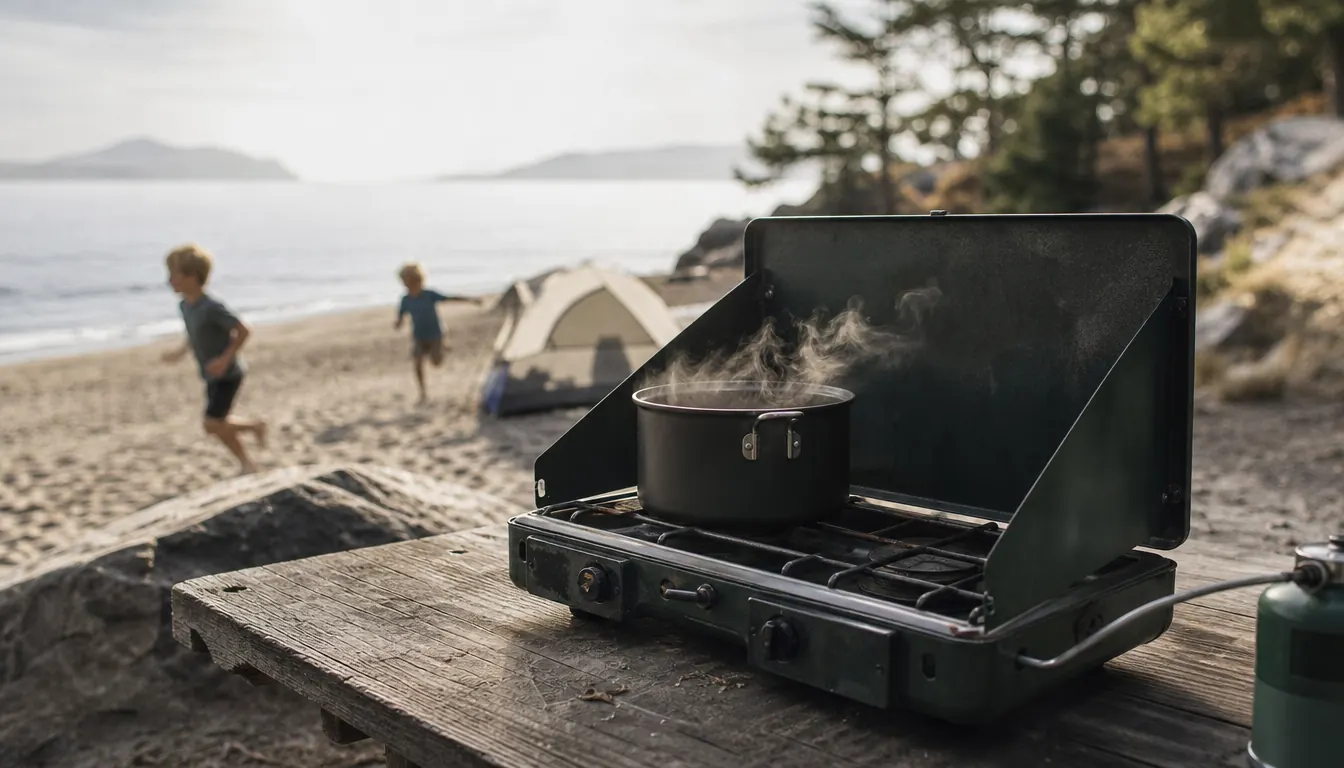
I'll be honest with you before we get to the stove: the first thing I noticed about the Coleman Triton 2-Burner Stove had nothing to do with flames or wind. It was the weight when I lifted it out of the bed of my Tundra. This is a solid piece of gear, not a toy, and after a decade of hauling cheap burners in and out of the truck, solid is exactly what I was after. Over three long weekends of cooking for a crew of grandkids at beach parks around Oahu, it taught me what nobody puts on the box.
The short version: it's a strong, dependable two-burner that feeds five hungry grandkids and a retired coach without drama. The long version has a few surprises, some good, some worth knowing before you buy. That's what this honest review is for.
The Quick Verdict
A heavy, powerful two-burner that handles wind better than most, once you learn its quirks. Simmer control and cleanup are the honest tradeoffs.
Amazon Check Today's Price →The burner that survived three windy beach weekends
If you feed a big crew on car camping trips, the Coleman Triton is the one I keep grabbing. Check today's price on Amazon.
Amazon Check Today's Price on Amazon →How I've Used It
I run the stove on long weekends, Friday to Monday, at a county beach park on the west side. That means three breakfasts, three dinners, and a constant stream of coffee and hot water for cocoa. My crew on these trips is usually three to five grandkids, ages six to fifteen, plus me. When the kids are hungry, they're hungry all at once, so I need two burners working together, not one burner and a lot of patience.
I've cooked pancakes for eight, a big pot of chili, foil packets of fish, eggs and bacon in one skillet, and a pot of rice on the other burner at the same time. The stove sits on the picnic table, out of the sand, with the propane bottle on the ground and the hose reaching up. I set it up in about two minutes and I don't think about it again until it's time to cook.
For this review, I kept notes across six full cooking days in real conditions. I cooked in the morning breeze, in an afternoon gust that kept flipping my hat, and one evening with a steady trade wind. I also used it at home twice, on the back patio, to compare it against a stove I've had for years. That gave me a fair sense of what the Triton does that the cheaper ones don't.
First trip with it was a three-day weekend at a county beach park. I set it up Friday afternoon on the picnic table, cracked a fresh bottle of propane in, and lit both burners. My granddaughter asked what was for dinner and I told her chili, which is only true if it's bubbling, and this stove had it bubbling in a way my old one never did. That first pot of chili told me more than any spec sheet: two burners, full heat, no fuss, dinner for six on time.
What Nobody Tells You About the Flame
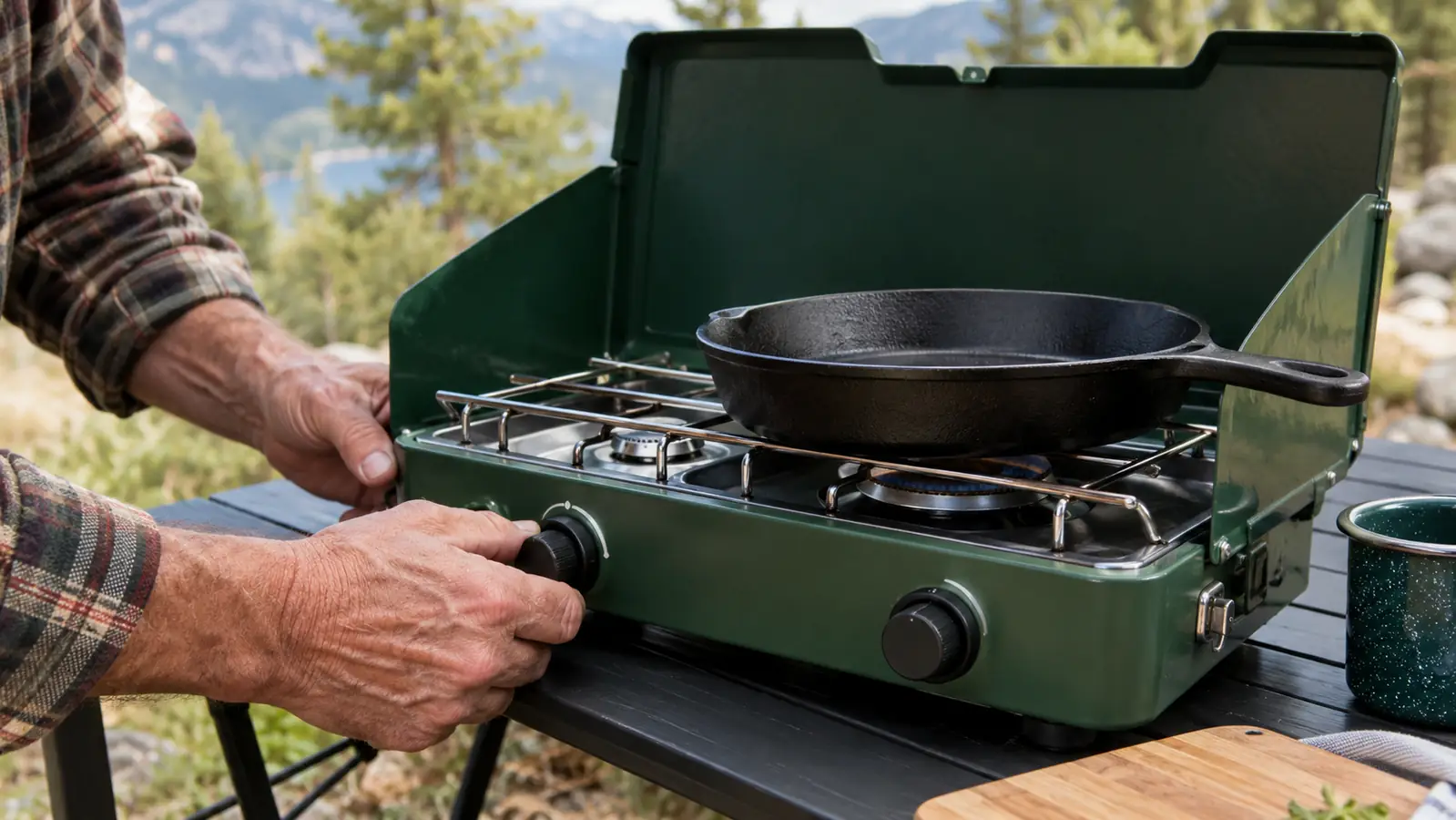
Start with the flame, because that's the heart of any stove. The Triton puts out serious heat. A big skillet of bacon comes up to temperature faster than I expected, and a pot of water for pasta boils in a hurry. If you've cooked on those little single burners that take forever, this is a different world. You set the dial, the blue flame covers the burner, and the food cooks.
The thing nobody tells you: the low end is the weak spot. The dials run from high to low, and the low setting still puts out more fire than you want for a gentle simmer. Rice came out a little crunchy the first time I tried it because I left the burner where I thought low was. You learn to nudge the dial almost to off and babysit it, or you cook rice with the lid on and pull it off the heat at the right moment. For a family camping stove that's a fair tradeoff. Just don't expect restaurant simmer control.
Another thing worth knowing: the burners are close enough together that a big griddle can span both, which is how I feed a crowd of kids pancakes without waiting. That's the setup that sold me. Two burners under one griddle is the difference between feeding five kids and feeding them one at a time.
If Coleman asked me what I'd change, it's the knob feel. The high end is obvious, but the low end has a long dead zone where the flame barely moves, and then suddenly it drops. I'd trade a little of that high heat for a smoother taper at the bottom. It's a small thing on a stove this capable, but it's the difference between good and great for anyone who likes rice or slow beans.
What Nobody Tells You About Wind
Every beach park on Oahu has a breeze, and some have a breeze that means business. The Triton has built-in wind guards that wrap around the sides, and they help. On a normal morning I could keep a pot of rice at a steady bubble with the guards up. That alone puts it ahead of the bare burners I've used in the past, where a gust could kill the flame and leave breakfast half done.
Here's the honest part: the wind guards are not a wall. In a strong, steady trade wind, the flame still flickers, and if the gust comes straight down the table, the outside burner will struggle. I learned to set up the stove with the short end facing the prevailing wind, and I sometimes put a cooler on the windward side of the table as a break. Once I did that, the stove held its flame through an evening that flattened my paper plates. The guards buy you a lot of margin, just not total protection.
Also worth knowing: the lid, when it's flipped open, does some of the wind work for you. I didn't expect that. The lid stands up behind the burners, so if you orient the stove with the lid facing into the breeze, you get a decent windbreak for free. It sounds like a small thing, but on a gusty beach it's the difference between cooking and chasing your flame.
One evening the wind was strong enough that I had to cook with the cooler up on the table beside the stove. That's not the stove's fault, that's beach camping. But the Triton held its flame where my old stove would have needed a full windshield. I'll take that.
What Nobody Tells You About Cleanup
Cleanup is where a camping stove earns its keep, and the Triton is better than most but not as easy as the marketing makes it sound. There's a removable grease tray that slides out from the front. After a weekend of bacon and sausage, that tray catches a surprising amount of fat, and it wipes clean in a minute. That's the part I appreciate most, because the old stove I used before this one just let grease run down the front and bake on.
The other part: the drip trays under the burners catch spills, and they're removable too. You'll want to take them out and wash them after a greasy weekend, because bacon grease that sits in a warm drip tray gets sticky fast. A little dish soap and hot water at the camp sink handles it. I also learned to brush crumbs and ash off the burner heads before I close the lid, because leftover bits just bake on the next time.
The case is a hardshell that closes up with the grates and wind guards inside, which means it packs flat and stacks in the bed of the truck without scratching. The latch is solid, and the whole thing feels like it was built to be thrown around a little. After six full cooking days, including a few knocks in and out of the Tundra, it still looks like a stove that's just getting broken in.
Here's the thing about the grease tray that nobody mentions: you should empty it before it fills, not after. I learned this the hard way on day two of a trip when a full tray tipped as I slid it out. It's an easy wipe-up on the table, but it's a two-hand job when the tray is full. Pull it halfway, check the level, and you'll never have my problem.
Build Quality and the Weight Tradeoff
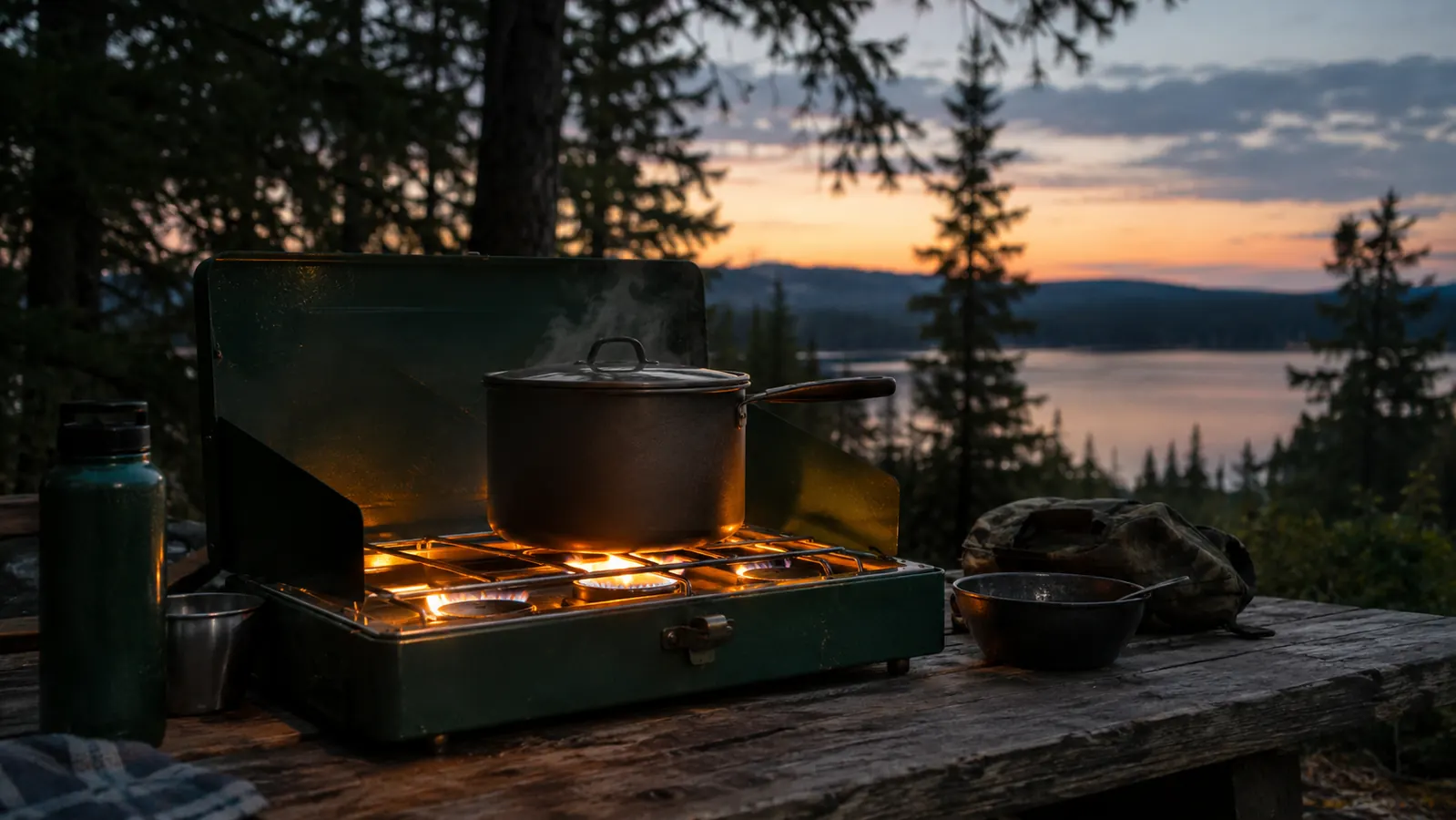
Let's talk about weight, because nobody talks about weight. This stove is heavy. I'm not a small man and I still notice it when I lift it from the truck bed to the picnic table. You're trading lightness for metal that doesn't flex and a frame that doesn't wobble. The knobs are solid, the regulator is built into the hose, and the legs lock into place without rattling. If you carry your stove more than a few feet, you'll feel the difference. If you're car camping like me, you'll trade the weight for the sturdiness every time.
I've had cheap stoves where the legs bent in the first season and the valve got stiff. The Triton's legs are a different kind of part entirely. The stove sits square on uneven table surfaces, and the legs have a wider stance than the old models, so a big pot of chili doesn't make it want to tip. That stability matters when you've got kids moving around the table.
One more note on the regulator: it threads onto a standard 16.4-ounce propane bottle the same way every other stove I've used does, so there was no learning curve. The hose is short enough to stay out of the way and long enough to get the bottle off the table. I keep a spare bottle in the truck, and swapping one in mid-cook takes about twenty seconds.
The regulator hose is the other thing I checked carefully, because that's where cheap stoves fail. On the Triton, the hose is stiff enough to hold its shape without kinking, and the connection to the bottle threads on smooth. After a season of use, I've had no hissing, no loose fittings, no smell of gas. That's the kind of boring detail that keeps a coach happy.
Alternatives I Considered
I'll be straight: I looked at the Camp Chef Everest before I settled on the Triton. It's a fine stove, a little bigger burners and a little higher price, and a lot of campers swear by it. For my trips, the Triton wins on two things: the wind guards do more work in a beach breeze, and the hardshell case packs flatter in my truck. If I were cooking at altitude in the mountains on a mainland trip, the Everest might win the argument. For beach parks in Hawaii, the Triton is the one I reach for.
I also considered going back to a single burner and a griddle, since I feed a crowd. But a single burner means one thing at a time, and one thing at a time doesn't feed five hungry kids. Two burners under one griddle is the minimum for a crew this size, and the Triton does that without flexing. That's the whole argument in one sentence.
The other thing I checked was ignition, because that's where a lot of stoves nickel and dime you. The model I use doesn't have a push-button igniter, so I light it with a long-reach lighter. That works fine, but if you forget the lighter at home, you're borrowing a match from the neighbor at the next site. I keep a spare lighter in the stove case now, tucked beside the grease tray, so it's always there.
What I Liked
- Serious heat on both burners; a big skillet or griddle cooks fast
- Wind guards and the flip-up lid handle beach breezes better than any stove I've used
- Removable grease tray and drip trays make cleanup genuinely easier
- Solid build, wide stance, no wobble under a heavy pot
- Hardshell case packs flat and stacks clean in the truck
Where It Falls Short
- Low setting still runs hot; gentle simmering needs babysitting
- Heavy, you'll feel it carrying from the truck to the table
- Wind guards help but don't fully tame a strong trade wind
- Drip trays need a real wash after greasy weekends
The grease tray caught every drop of bacon fat from a weekend of cooking for five kids, and wiped clean in a minute. That's what sold me on the Triton.
Who This Is For
If you car camp, if you cook for more than two people, and if you've ever stood in a wind gust watching a burner flame dance, this stove is for you. It's for the family that eats breakfast together at a picnic table and the coach who wants the coffee ready before the kids wake up. It's for people who pack a truck, not a backpack, and who would rather carry a few extra pounds than eat dinner late.
Who Should Skip It
If you backpack, if you eat mostly freeze-dried meals, or if you cook for just one or two, this stove is more than you need. The weight will annoy you on any trail longer than a parking lot. And if you need a true simmer for fancy cooking, the low burner will frustrate you. This is a workhorse for a crew, not a precision instrument for a chef.
Ready to feed the whole crew without the wind winning?
The Coleman Triton is the stove I keep in the truck for every long weekend. See today's price on Amazon before your next trip.
Amazon Check Today's Price on Amazon →