
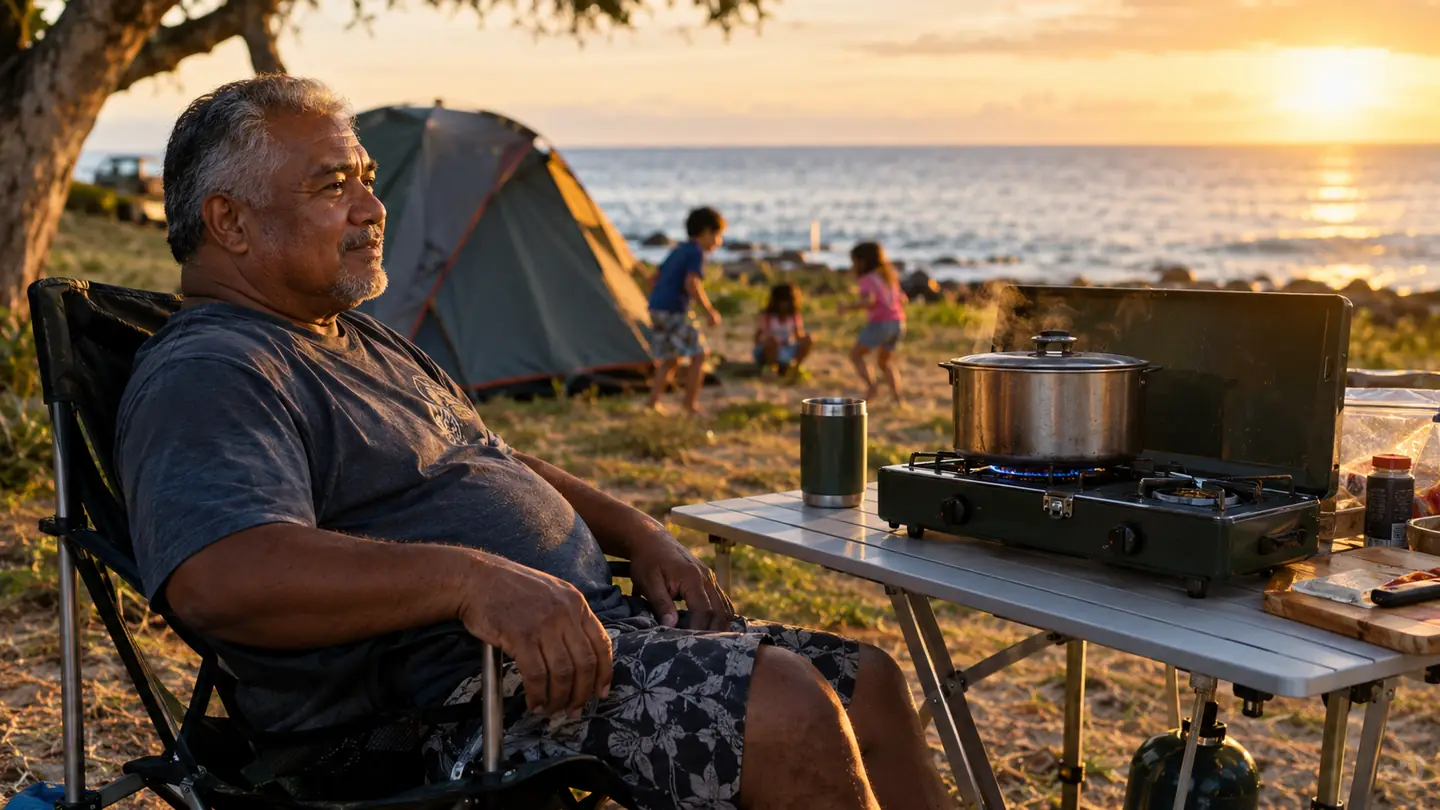
I have cooked for a lot of hungry people in my life. Friday night team meals for forty players, sideline snacks for the whole coaching staff, and now a rotating crew of grandkids who act like they have not eaten in a week the second we pull into a campsite. So when I tell you the Coleman Triton 2-Burner Propane Stove has been the workhorse of our car camping setup for two full seasons, I mean it in the same way I mean it when I say a kid can play defense. I have watched it long enough to know.
This is not a first-weekend review. This is the stove that has cooked breakfast for eight, boiled water for coffee before sunrise, simmered chili through a rainy afternoon, and fed three generations of my family from a folding table at state beach parks across Oahu. Here is what two years of real use taught me about the Coleman Triton.
The Quick Verdict
The Coleman Triton is the most dependable two-burner stove I have used in decades of car camping. It is not the most powerful or the most compact, but it lights every time, holds a steady simmer, and has never left my crew hungry.
Amazon Check Today's Price →Feed the whole crew without the campfire fuss
Two burners, instant ignition, and wind guards that actually work. This is the stove I trust for every long weekend with the grandkids.
Amazon Check Today's Price on Amazon →How I've Used It
I bought the Coleman Triton in the spring of 2024, right before our first three-day weekend at a county beach park on the windward side of Oahu. My old single-burner stove had finally given up, and I needed something that could handle breakfast for five grandkids and still have a burner free for the coffee pot. I had been through three stoves in the previous decade, and each one let me down in a different way. One lost its ignition in the first season. One had a regulator that froze up on a cool morning. The third simply stopped holding a steady flame, and I gave up on it. I wanted something boring and dependable, and that is exactly what Coleman builds. The Triton was the obvious choice: Coleman has been making camp stoves longer than I have been coaching, and the price was right.
Since then, the stove has been on at least twenty weekend trips. It rides in the bed of my silver Toyota Tundra, wrapped in an old towel, and it has been rained on, splashed with pancake batter, covered in sand, and knocked over once by a dog at the next campsite. It has never missed a meal. On the Memorial Day weekend alone, we cooked for eleven people across three days, and I never once had to wait for a burner to cool down before starting the next pan. The stove handled a dozen eggs, a pound of bacon, a pot of rice, and a big skillet of french toast before nine in the morning, and it was still ready for lunch. I have cooked eggs, bacon, french toast, stir fry, chili, spaghetti, and enough pots of rice to feed a small village.
The setup is simple. The legs fold out, the regulator snaps onto a one-pound propane cylinder, and the matchless ignition lights both burners on the first click almost every time. I can go from the back of the truck to a boiling pot of water in about four minutes, which matters when you have a six-year-old asking when breakfast is ready.
One morning in particular sold me on this stove. It was a Saturday in March, the wind was coming off the water hard enough to bend the tent poles, and I had promised the kids pancakes. The wind was steady at maybe fifteen miles an hour, gusting higher, and the flags at the lifeguard stand were standing straight out. My old stove would have taken twenty minutes and a lot of bad language to get going. The Coleman Triton lit on the first click, the wind guards held the flame steady, and I had a stack of pancakes on the table before the coffee finished dripping. The pancakes came out even, no raw middle, no burned edge. That was the morning I stopped thinking of it as a new stove and started thinking of it as part of the family gear.
What Makes the Coleman Triton Different
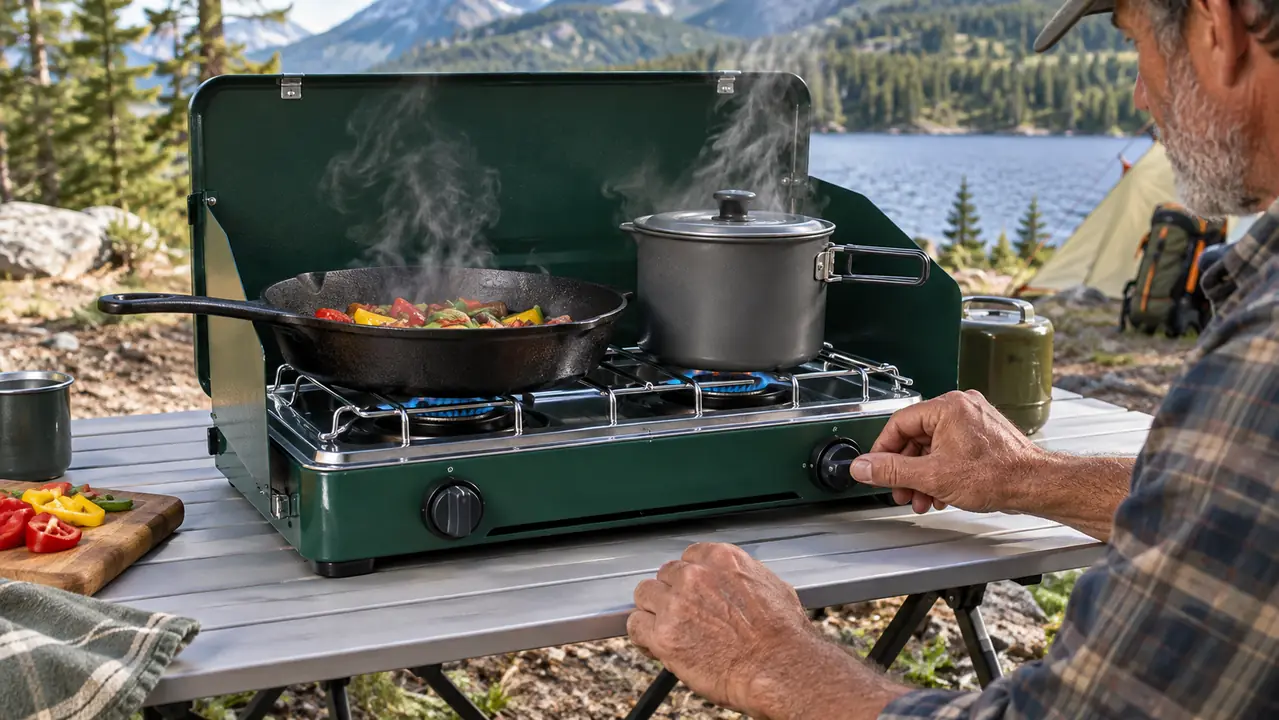
The first thing you notice is the wind guards. They wrap around three sides of the burners and they actually do something. We camp on the windward coast a lot, and the trade winds can turn a good breakfast into a cold one fast. With the Triton, I can cook eggs and bacon in conditions that used to mean eating granola bars. I have used stoves with thin metal shields that rattled in the breeze and did nothing. The Triton guards are sturdy enough that a gust does not move the flame at all. The guards fold down flat when the stove is closed, so they do not add bulk.
The second thing is the matchless ignition. I have owned stoves where you needed a lighter and the patience of a saint. The Triton lights on the first click, even after the stove has been bouncing around in the truck bed for an hour. That sounds like a small thing until you are standing in the dark at 5:30 in the morning with a pot of water in your hand.
The third thing is the simmer control. This is where a lot of camp stoves lose me. They either blast on high or barely flicker, and you cannot get a pot of rice to cook evenly to save your life. The Triton has a real range. I can bring a pot of chili to a rolling boil and then dial it back to a gentle simmer that does not scorch the bottom. The knob has a wide low range, not a tiny sliver of travel between 'off' and 'low'. You can feel the flame settle, and you can fine-tune it by a quarter turn. That matters for a pot of beans simmering all afternoon while the kids swim. For a guy who cooks for a crowd, that is the difference between a good meal and a great one.
I will give you a specific example. On a trip in July, I made a pot of jambalaya for nine people. I browned the sausage on high, added the rice and broth, and brought it to a boil. Then I turned the knob down to the low end and let it sit for twenty minutes while I helped the youngest grandkid fly a kite. When I came back, the rice was cooked through, the bottom was not scorched, and nobody had to scrape a burned pot. That kind of control is rare in a camp stove, and it is the reason I reach for the Triton instead of the fire pit.
Performance Over Time
Two years in, the Coleman Triton still lights on the first click. The burners have not clogged, the regulator has not leaked, and the folding legs are as tight as the day I bought it. I have not had to replace a single part. That is not something I can say about any other camp stove I have owned.
The one thing I have noticed is that the grates have started to show some wear. The black coating has worn off in a few spots where the pans sit, and there is a little surface rust on one corner. I noticed it around the one-year mark, after a stretch of damp trips in the winter. It has not spread much since, and it does not touch the food. It does not affect cooking at all, but if you are the kind of person who keeps gear showroom clean, you should know it is not a forever finish.
The wind guards have held up better than I expected. They get bent a little if you are not careful when you fold them, but they bend back easily. The latch that holds the lid closed is still solid, which matters because the stove lives in the truck bed between trips.
I have also learned a few things about keeping it happy. I wipe the burners down with a dry rag after a wet trip, and I give the whole stove a shake before I pack it to make sure no sand is sitting in the works. Once, after a trip where the stove sat in a light rain for an hour, the ignition took two clicks instead of one. That was at Kualoa Regional Park in December, and the stove had been left out while we packed the truck. I dried it out, and it has been fine ever since. That is the only hiccup in two years, and I blame myself for leaving it out in the weather.
Two years and twenty trips in, the Coleman Triton still lights on the first click. I have not had to replace a single part.
The Tradeoffs Nobody Mentions
Let me be straight with you. The Coleman Triton is not the most powerful two-burner stove on the market. Each burner puts out about 11,000 BTUs, which is plenty for most cooking, but if you are trying to boil a big pot of water in a hurry, it takes a few minutes longer than a higher-output stove. I have clocked a two-quart pot of water at about eight minutes to a rolling boil, which is fine once you plan around it. I have learned to start the water before I start the bacon, and everything is ready at the same time.
The other thing is the footprint. This is a full-size two-burner stove, and it takes up a good chunk of the folding table. If you are cooking for two people out of the back of a hatchback, it might be more stove than you need. For my crew, the size is exactly right. I can fit a 12-inch skillet on one burner and a two-quart pot on the other, and still have room for a cutting board on the side.
The one-pound propane cylinders are convenient, but they do not last forever. A heavy cooking weekend will go through two or three of them. One Christmas week trip, cooking three meals a day for eight people, we used four. I started carrying the adapter hose and a five-gallon refillable tank after that, and now I only touch the one-pound cylinders when we are on a short overnight. The adapter screws on in a minute and costs less than a couple of cylinders, and it turns the Triton into a stove that can cook for a week without a trip to the store.
There is one more thing I want to mention, and it is the kind of detail that only shows up after a lot of meals. The knobs are marked clearly, which sounds like a small thing, but when you are cooking in the dark at 6:00 in the morning, you do not want to guess which knob is the left burner and which is the right. The Triton has the burners labeled, and the knobs turn smoothly even with cold hands. I have used stoves where the knobs were stiff and the markings wore off in a season. That has not happened here.
Who This Is For
The Coleman Triton is for the car camper who actually cooks. If you are the person at the campsite making breakfast while everyone else is still unzipping their tent, this stove is built for you. It is also for the family that camps with a crowd. When you have three or four grandkids circling the table asking when the pancakes are done, you need a stove that can keep up without a lot of fuss.
It is a great first stove for a young family, too. The controls are simple enough that a teenager can learn to use it safely, and the price means you are not terrified when it gets a little beat up. That is the kind of gear I like to hand down.
Who Should Skip It
If you are a backpacker, this is not your stove. At over ten pounds, the Triton belongs in the back of a truck, not on your back. If you mostly cook freeze-dried meals and boil water for coffee, a single-burner stove will save you space and weight.
If you need maximum power for serious outdoor cooking, like searing a steak at high heat or boiling a huge pot of water in record time, there are stoves with bigger burners. The Triton is a steady, reliable cooker, not a jet engine. For the way my family camps, that is exactly what I want.
What I Liked
- Matchless ignition lights on the first click, every time
- Wind guards that actually block the breeze
- Real simmer control for rice, chili, and sauces
- Folding legs and a solid latch for easy transport
- Two full-size burners fit a 12-inch skillet and a pot at once
- Coleman build quality that has lasted two seasons without a repair
Where It Falls Short
- Not the most powerful burners for rapid boiling
- Full-size footprint takes up most of a folding table
- Grates show wear and light surface rust over time
- One-pound cylinders run out fast on heavy cooking weekends
The stove that has never missed a meal in two years
If you cook for a crowd on long weekends, the Coleman Triton is the dependable workhorse you want on the table. Check the current price and see why it is the stove I recommend to every young family I coach.
Amazon Check Today's Price on Amazon →