

Every three-day weekend, I back the silver Tundra down to a beach park on the leeward side of Oahu with the bed full of camp chairs, a cooler, and three or four grandkids who've asked 'how much longer' twice before we clear Kapolei. I'm Sam, a retired high school football coach from Kapolei, and I've been doing this long-weekend routine for decades. Somewhere in that pile is a question I hear from parents at youth basketball practice more than you'd think: rechargeable lantern or the old battery kind? I've run both all season. The Lepro rechargeable LED lantern is the one I grab first, and this is the honest version of why, including the reasons a classic D-cell lantern still earns a spot in the truck.
Short answer: for a long weekend of car camping with a crew of kids, the Lepro wins on brightness, weight, and never buying batteries. The classic D-cell lantern wins on raw staying power and the ability to refuel at any store on the island. The right pick comes down to one question: how far are you from an outlet, and how many nights do you need light before you see one again?
| Lepro 1000LM Rechargeable Lantern | Coleman Classic D-Cell Lantern | |
|---|---|---|
| Power source | Built-in 4400mAh battery, charged over USB | Three D-cell batteries, bought and replaced by you |
| Brightness and modes | Four modes from a soft glow up to 1000 lumens | Usually one setting, sometimes two, around 300 to 500 lumens |
| Weight | Light enough to hang from a tent loop, no batteries to add | Heavier, and the three batteries ride with it |
| Runtime per fill-up | Up to about 12 hours on the low mode | Fifty to a hundred hours on one set of D-cells |
| Refueling on the road | Needs a USB port for a few hours | Any store sells D-cells; two minutes and you're lit again |
| Cost over time | You pay once, the battery is built in | You keep buying D-cells all season |
| Best for | Long weekends where the truck or camp store has USB power | A week off-grid with no outlet anywhere nearby |
How I Tested These
I didn't test these in a lab. I tested them the way most families actually camp. Three-day weekends at state and county beach parks, the truck backed up to the site, the tent up before dark, dinner on the camp stove, and a card game on the picnic table after. That routine gives every lantern the same four tests. Can the kids see the cards? Can the six-year-old get to the bathroom without waking up the nine-year-old? Can I find the water bottle at 2am? And the one nobody talks about: did I remember to charge it?
I ran the Lepro as the main light all season and kept the Coleman D-cell lantern as the backup in the truck bed. That's the setup I keep coming back to, and the longer I used it, the more I understood why both lights deserve a place in the rotation. The Lepro handled the everyday jobs. The Coleman handled the what-ifs. It's the same kind of lantern I grew up seeing at every campsite, and it still has a place, but it isn't the first thing I pack.

Where the Lepro Wins
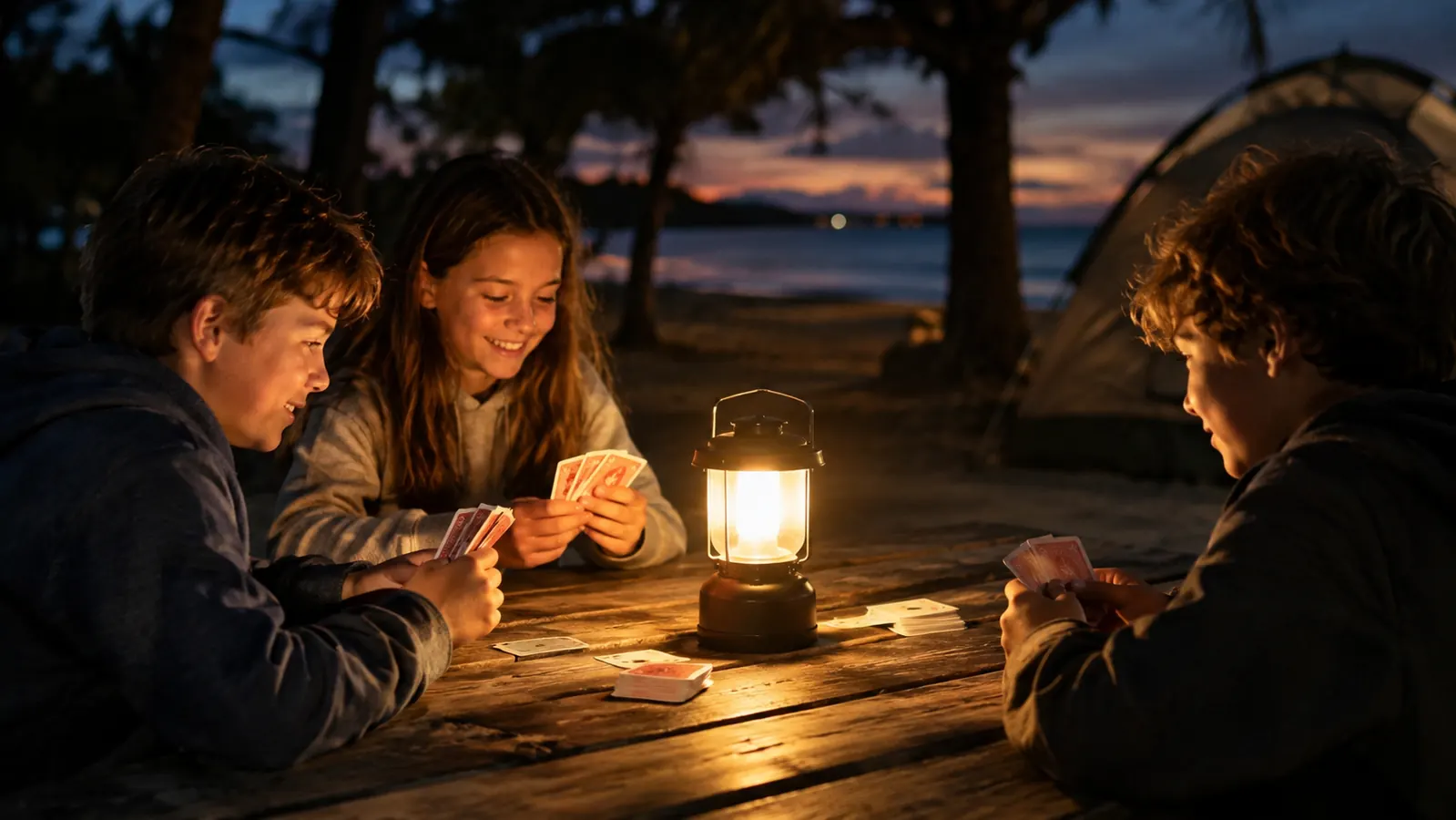
Start with the light itself. At full power, the Lepro lights up the whole picnic table, the card game, and the two kids who are supposed to be brushing their teeth but are actually building something out of sticks. A classic D-cell lantern throws a decent circle of light, but it's usually one setting, sometimes two, and that's it. The Lepro has four modes. That sounds like a small thing until bedtime, when the six-year-old is asleep in the tent and the nine-year-old still needs the bathroom. I drop it to the low glow, hang it from the loop, and nobody wakes up. It's the difference between running one play and having a whole playbook.
Then there's the weight and the money. The Lepro is light, with the battery built in, and it hangs from the tent loop without dragging the ridge down. A D-cell lantern is heavier, and the three batteries ride with it. At 63, I feel every pound I haul from the truck to the site, so I've learned to be ruthless about what comes along. Charging is the real kicker. I plug the Lepro into the USB port in the Tundra on the drive over, or into any outlet at the camp store, and a few hours later it's full again. I haven't bought a lantern battery all season, and I can't tell you the last time I stood in an aisle trying to remember whether the lantern takes C cells or D cells.
The loop on top earns its keep too. The Lepro hangs out of the way, and a light out of the way is exactly where it belongs when there are six-year-olds in the campsite. With the D-cell lantern, you set it on the cooler or the table, and with kids running around, someone will knock it over sooner or later. I've had a D-cell lantern roll off a picnic table and keep working. I've also had one go out mid-game. The Lepro just hangs there and does its job.
The Lepro lit the whole picnic table for a card game with four grandkids, and I never once bought batteries all season.
Where the Coleman Wins
Now the honest part, because this is where the D-cell lantern earns its keep. A classic Coleman D-cell lantern runs fifty to a hundred hours on one set of batteries. The Lepro on its low mode is good for roughly twelve hours on a full charge. For a long weekend, that's plenty, because I can charge it in the truck. But if you're parked at a beach park for a full week with no outlet anywhere, or you're camping somewhere the truck doesn't go, the D-cell lantern wins outright. Three D-cells and it's lighting your site every night for a week and a half. That's staying power the Lepro can't match, and I won't pretend otherwise.
The other thing the Coleman has going for it is the refuel. Any store on the island sells D-cells. Two minutes and you're back in business. There's nothing to charge, nothing to remember, and not much to break. If a kid knocks it off the table, it shrugs it off. If the power goes out at home during hurricane season, which on Oahu is not a hypothetical, I can grab it in the dark and it just works. The classic lantern is the fullback of the gear bag. Not flashy, but it shows up and carries the ball every single time. That's worth something, even if it isn't the light I reach for first.
One more point for the old light: it's simple enough that anyone can run it. The Lepro has modes and a charging cable and a battery that needs planning. The Coleman is a switch and a bulb. If the power goes out in the middle of the night, anyone in the house can find the D-cell lantern and make it work without reading a manual. There's real value in a light that asks nothing of you.
The lantern I grab first for every long weekend
The Lepro 1000LM gives you four light modes up to a full 1000 lumens, a built-in 4400mAh battery, and USB charging from the truck or any outlet. With more than 33,000 ratings on Amazon, it's the lantern that got me out of the battery aisle for good.
Amazon Check Today's Price on Amazon →The Fine Print on Rechargeables
The main thing nobody hands you with a rechargeable is the remembering. A D-cell lantern is always ready, because the batteries have been sitting in the drawer for two years. The Lepro only helps if you charged it, and a flat rechargeable is a paperweight until you find a USB port. I handle that with a habit: the lantern lives on the charger in the garage between trips, and it goes into the truck the night before we leave. The charging cable stays in the glove box, so it's always with the truck. Make that a habit and the problem disappears. Skip it once and you'll be borrowing light from the neighbors.
The other fine print is the cold. Batteries of any kind lose punch in cold weather, and a built-in battery is no different. For Hawaii beach parks that's rarely an issue, but if you camp in the mountains or on the mainland in winter, keep the lantern inside the tent or in the cab instead of the truck bed. And one more thing: the low mode is your friend. You don't need 1000 lumens to read a book. Run the low glow at night and the charge stretches across the whole weekend.
The One Question That Decides It
So how do you choose? I keep coming back to one question: can you charge it where you camp? If the answer is yes, and for most car campers it is, the rechargeable is the better lantern. The Tundra has a USB port. The camp store has outlets. The visitor center at the state park has a plug near the restrooms. That covers ninety percent of my trips.
If the answer is no, if you're a week from the nearest outlet, or you want a light that works no matter what, the D-cell lantern is the honest pick. That's not a knock on the Lepro. It's just physics. Batteries store energy you can replace anywhere. A built-in battery stores energy you replace from a wall. Different jobs, different tools.
What the Grandkids Think
I asked the crew, because they're the real testers. The card game test happens every trip: after dinner, four grandkids and a deck of cards on the picnic table. With the Lepro at full power, nobody squints and nobody argues about whose turn it is because they can't see the cards. With the D-cell lantern, we had to move the game under the awning, and even then the far side of the table stayed dim. There's a whole separate list on this site about why a good LED lantern keeps kids safe at night, and the card game test is on it.
The bedtime test is the one that sold me. The six-year-old doesn't like the dark. The Lepro on the lowest mode is a soft glow that lets her settle down without turning the whole tent into a lighthouse. The D-cell lantern has one setting, and it was either too bright for bedtime or too dark to find the water bottle. Four modes beat one mode when you're camping with kids. That's not marketing. That's a 63-year-old man squinting at a card game at 9pm.
Who Should Buy Which
Here's how I'd put it at the kitchen table. If you're a long-weekend car camper like me, with USB ports in the truck and outlets at the camp store, buy the Lepro. It's brighter, lighter, and you stop buying batteries, full stop. If you camp a week at a stretch with no power, or you want a zero-thinking emergency light for the house, buy a classic D-cell lantern and keep a spare set of batteries in the drawer. Most families, honestly, should do what I do: make the Lepro the main light and keep one cheap D-cell lantern as the backup that lives in the truck, ready when the rechargeable is flat and the nearest outlet is an hour away. If you want the full-season story, there's a longer Lepro review on this site that goes deeper into how the lantern holds up over months of use.
Ditch the battery aisle for good
The Lepro 1000LM rechargeable lantern gives you four light modes, a built-in 4400mAh battery, and USB charging. It's the lantern I pack first for every long weekend, and it's kept the grandkids happy at the beach park all season.
Amazon See Today's Price on Amazon →